
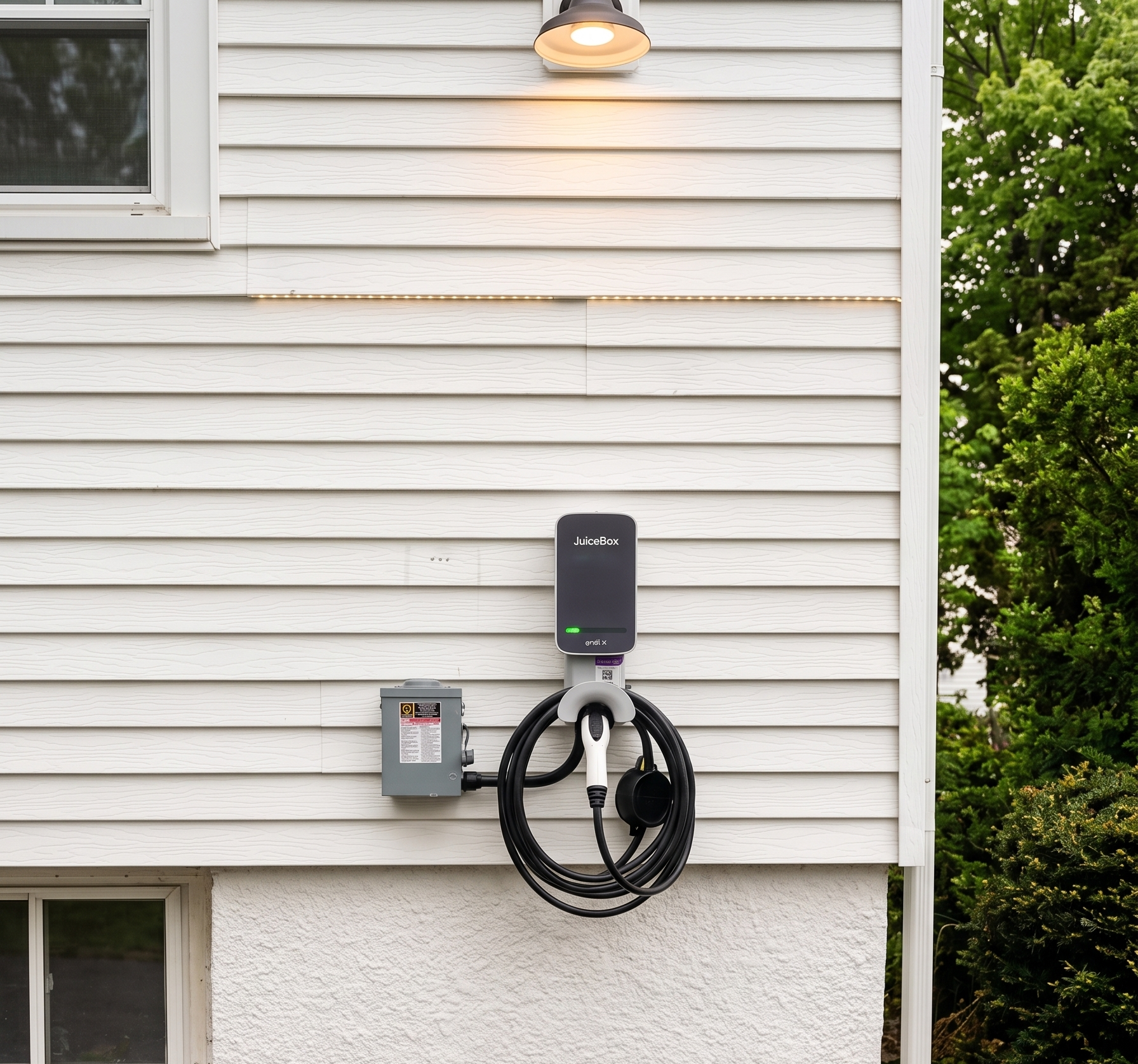
If you drive an electric car here, your fuel bill moved from the gas station to your utility account. EV charging in Connecticut still beats gasoline on cost. It is not free, though, and this state carries some of the highest electric rates in the country.
Here is the honest math on what home charging adds to your bill. We will also cover the 2026 rebate changes and where solar fits.
What Home Charging Actually Adds to Your Bill
Start with miles, not kilowatt-hours. The average American drives roughly 1,000 miles a month. Most EVs use 25 to 35 kWh per 100 miles.
That works out to about 300 kWh a month for a typical driver. Cold New England winters push that number higher, often by 15% to 25%.
Rates are what make this expensive. Eversource and United Illuminating customers pay well above the national average of about 19 cents per kWh. All-in residential rates here have averaged in the mid-20s this year.
At 25 cents per kWh, 300 kWh a month costs roughly $75. Over a year that is about $900 on your electric bill. Add a second EV and you are approaching $1,800.
Connecticut Bills Dropped in 2026, But the Reason Matters
Something unusual happened this year. Bills across the state fell by double digits, and two state actions drove most of that.
PURA converted the public benefits charge into a bill credit back in May. Standard service supply rates then dropped on July 1. Eversource moved to 11.577 cents per kWh and UI to about 11.99 cents.
That credit is worth about $30 to $34 on a typical monthly bill. It is funded partly by state borrowing and runs through April 30, 2027.
Read that date carefully. A credit paid for with borrowed money is a temporary subsidy, not a permanent rate cut. Nobody has committed to funding it past next spring.
So if you are adding an EV, you are adding load right as that cushion approaches an expiration date.
The 2026 Charger Rebate Rules Changed
Connecticut used to hand out generous EV charger rebates to nearly everyone. That changed on January 1, 2026.
Lawmakers narrowed the program in July 2025. Upfront rebates of up to $1,500 cover a Level 2 charger and panel wiring. They now go only to households at or below 300% of the federal poverty level, or to homes in designated high-poverty, low-opportunity areas.
Do not qualify? Then you pay for the charger and the electrical work yourself. Budget for both. Plenty of older Connecticut homes need a panel upgrade before a 48-amp charger goes in.
Managed charging remains open more broadly. Eversource and UI pay a $100 enrollment incentive. Participants can also earn up to $300 a year for charging off peak.
Weekday peak hours run 3 p.m. to 9 p.m., and weekends count as off peak. CHEAPR, the state vehicle rebate, also shrank. The standard rebate is now $1,000 for a new EV, with larger Rebate+ amounts for income-eligible buyers.
Why Solar Changes the EV Math Here
An EV turns a variable cost into a predictable one. You know roughly how many kilowatt-hours you will burn each year.
Solar answers that number directly. Size the system around your driving, not just your household usage. That single choice separates covering half your bill from covering most of it.
A rough rule: 300 kWh a month of charging needs about 2.5 to 3 kW of added solar. On most Connecticut roofs that means six to eight extra panels.
The state compensates production through the Residential Renewable Energy Solutions program, or RRES. You choose between a netting tariff and a buy-all tariff. Either way, your rate locks for 20 years.
Twenty years of locked compensation is the part worth sitting with. Supply rates reset every six months here. State credits come and go with the budget.
Connecticut also exempts residential solar from sales tax and from added property tax assessment. Adding panels does not raise your assessment.
What About Battery Storage
Batteries and EVs pair well, though they solve different problems. A battery covers outages and shifts usage off peak.
Connecticut’s Energy Storage Solutions program changed on April 1, 2026. New enrollees now receive a smaller upfront enrollment incentive. They also earn performance payments over 10 years for letting the utility dispatch the battery.
We install Tesla Powerwall and we are happy to walk through whether the numbers work for your house. Sometimes they do not. We say so.
What We Tell Connecticut Homeowners
Infinity Energy has completed more than 10,000 installations across New York, New Jersey, and Connecticut. Our team holds Elite+ installer status on EnergySage, the top 4% nationally, plus an A+ rating with the BBB. EnergySage also named us Installer of the Year.
Our in-house roofing division matters more here than people expect. Does your roof have under 10 years left? Then do the roof and the solar together. Pulling an array to reroof later gets expensive fast.
Coverage runs 25 years on panels and production. Inverters carry 10 years, and our workmanship carries 5. We also offer $0 down financing.
Is It Worth Running the Numbers
Drive an EV in Connecticut and your electric bill is now your fuel bill. That makes a locked 20-year production rate more valuable to you than to a neighbor with two gas cars.
Bring us your last 12 months of usage, your driving habits, and your roof. We will tell you what a system would actually cover, with no pressure either way. Get a free quote and we will run the math for your address.